Badrinath Temple
Also known as Badrivishal
Northern Char Dham, at 3,133 metres on the bank of the Alaknanda. Open only six months of the year, from Akshaya Tritiya to Vijayadashami.
Photos of Badrinath Temple
Badrinath Temple at a Glance
| Location | Badrinath, Uttarakhand |
|---|---|
| Presiding deity | Vishnu |
| Established | Present form 8th century CE |
| Architecture | Garhwal |
| Timings | 04:30–13:00, 17:00–21:00 (May–Nov) |
| Best time to visit | May to June and September to October; the temple closes for the winter, roughly November to April. |
| Address | Badrinath, Chamoli 246422 |
About Badrinath Temple
Badrinath sits on the left bank of the Alaknanda in Chamoli district, between the Nar and Narayan mountain ranges and below the Neelkanth peak. It is the northern seat of the Char Dham and the foremost of the Vishnu shrines of the Himalaya, one of the 108 Divya Desams of Sri Vaishnava tradition.
The name is tied to the badari, the wild jujube tree under which Vishnu is said to have meditated, sheltered by his consort Lakshmi in the form of the tree. The presiding image, Badrinarayan, is a black stone figure seated in meditation, and tradition says Adi Shankara recovered it from the Alaknanda and enshrined it here.
History of Badrinath Temple
The temple is traditionally attributed to Adi Shankaracharya, who is said to have retrieved the black stone image of Badrinarayan from the Narada Kund below.
Architecture of Badrinath Temple
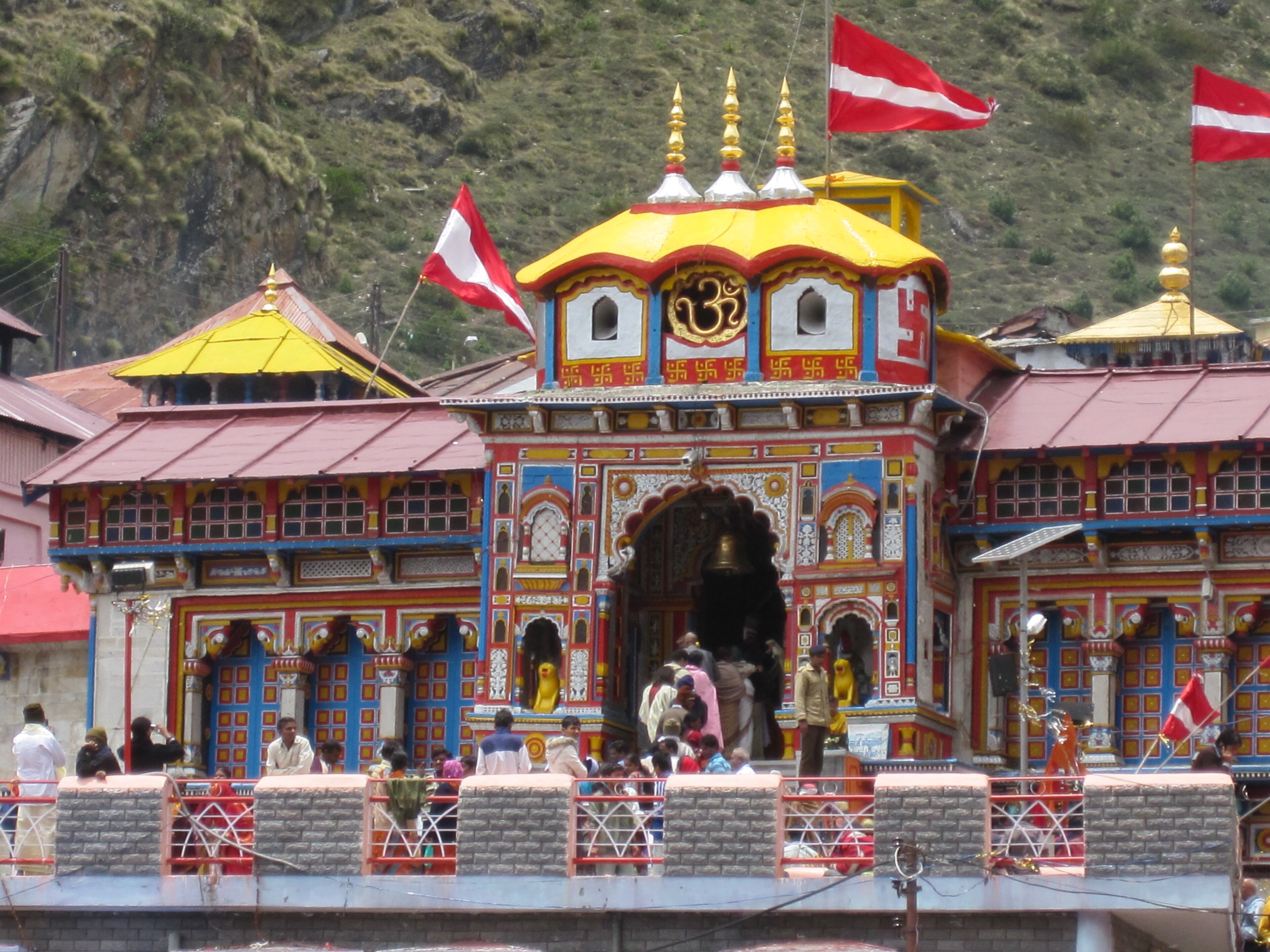
The shrine rises in three parts: the sanctum (garbhagriha), a pillared hall for worshippers (darshan mandap) and a hall for assemblies (sabha mandap). The façade is painted in bright colours, and the arched entrance gate and small gilded spire stand out sharply against the grey mountainside, a look closer to a Himalayan monastery than to the stone temples of the plains.
Below the temple, the Tapt Kund hot spring flows at the edge of the river. Pilgrims traditionally bathe there before entering the shrine.
Rituals and Worship at Badrinath Temple
The day begins with the Abhishek and the Maha Abhishek, followed by the offering of tulsi garlands, which is central to Vishnu worship. Pilgrims commonly offer prasad of sugar candy, dried fruit and tulsi leaves.
The head priest, the Rawal, is traditionally a Nambudiri Brahmin from Kerala, a custom linked to Shankara. As at Kedarnath, the deity is worshipped through the six warm months at Badrinath and moved down to Joshimath for winter worship.
Festivals Celebrated at Badrinath Temple
- Mata Murti ka Mela
- Badri Kedar Utsav
Visiting Badrinath Temple: Planning Your Trip
The usual road approach is from Rishikesh through Devprayag, Karnaprayag and Joshimath, a long day's drive on mountain roads. Many pilgrims break the journey at Joshimath. Registration for the Char Dham yatra is required, and the road can be closed by landslides during the monsoon, so check the status before leaving.
At about 3,100 m the air is thin but the setting is easier on visitors than Kedarnath. Allow time for Mana village, the last village before the Tibet border, a short drive away, and for the Vasudhara waterfall trek beyond it.
How to Reach Badrinath Temple
Reached by road from Rishikesh via Joshimath (295 km). Nearest airport is Dehradun; helicopter services also run in season.
Temples Near Badrinath Temple
- Kedarnath TempleUttarakhand · about 41 km in a straight line
- Gangotri TempleUttarakhand · about 60 km in a straight line
- Yamunotri TempleUttarakhand · about 103 km in a straight line
- Karu Devta Temple, DhumtiHimachal Pradesh · about 104 km in a straight line
- Charang MonasteryHimachal Pradesh · about 117 km in a straight line
- Mathi Temple, ChitkulHimachal Pradesh · about 121 km in a straight line
More Vishnu Temples to Visit
- Shri Badri Narayan ji Temple, BatseriHimachal Pradesh
- Kamru Fort (Badri Vishal Temple)Himachal Pradesh
- Shri Narayan Nagin Mata Temple, KalpaHimachal Pradesh
- Narayana Temple, RoghiHimachal Pradesh
- Kuldev Narayan Ji Temple, PanwiHimachal Pradesh
- Brahma SarovarHaryana
Frequently Asked Questions about Badrinath Temple
Where is Badrinath Temple located?
- Badrinath Temple is located at Badrinath, Chamoli 246422, in Badrinath, Uttarakhand, India.
Who is the presiding deity at Badrinath Temple?
- The presiding deity at Badrinath Temple is Vishnu (also known as Narayana, Hari), worshipped in the Vaishnava tradition.
What are the timings of Badrinath Temple?
- Badrinath Temple is generally open 04:30–13:00, 17:00–21:00 (May–Nov). Timings can vary on festival days and special occasions — verify with the temple before your visit.
When was Badrinath Temple built?
- Badrinath Temple was established Present form 8th century CE. Portions of the structure have been added and renovated by successive dynasties over the centuries.
What is the architectural style of Badrinath Temple?
- Badrinath Temple is built in the Garhwal style, characteristic of Vishnu shrines of this region.
Which festivals are celebrated at Badrinath Temple?
- The principal festivals celebrated at Badrinath Temple include Mata Murti ka Mela, Badri Kedar Utsav. These draw large crowds of pilgrims from across Uttarakhand and beyond.
How can I reach Badrinath Temple?
- Reached by road from Rishikesh via Joshimath (295 km). Nearest airport is Dehradun; helicopter services also run in season.
Why is Badrinath Temple significant?
- Northern Char Dham, at 3,133 metres on the bank of the Alaknanda. Open only six months of the year, from Akshaya Tritiya to Vijayadashami.
What is the best time to visit Badrinath Temple?
- May to June and September to October; the temple closes for the winter, roughly November to April.